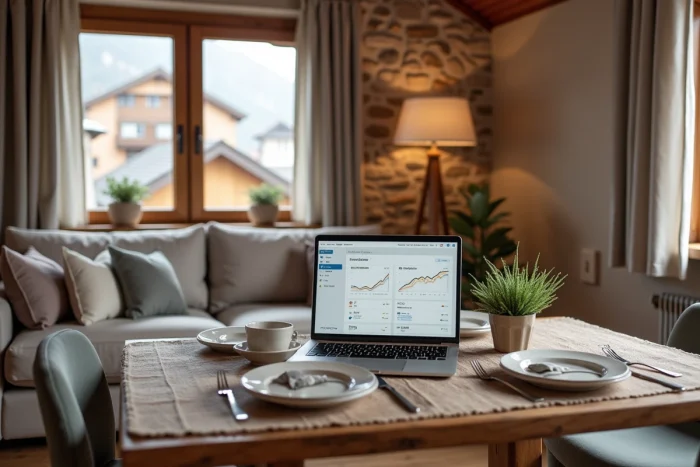
Short-term rentals in Chambéry generate a median annual income of around €16,834, with an average daily rate of €74 and an occupancy rate of 62%. These three indicators form the basis of any profitability calculation for a property rented out seasonally in this town in Savoie.
Average Daily Rate and RevPAR: Understanding Airbnb Profitability Indicators
Before projecting revenues, two metrics determine the actual performance of a listing. The average daily rate (ADR) corresponds to the average price collected per night booked. In Chambéry, it is around €74.
RevPAR (Revenue Per Available Room) relates this rate to the total number of available nights in the year, including those that remain vacant. According to AirROI data, the Chambéry RevPAR hovers around $39, indicating a moderate efficiency between the displayed price and the actual revenue received. A significant gap between ADR and RevPAR signals an insufficient occupancy rate or strong seasonality.
Detailed estimates published on the Pôle Immo site help contextualize these figures according to the type of accommodation and the targeted neighborhood.
Occupancy Rate in Chambéry: What 62% Really Means
An occupancy rate of 62% does not mean that the property remains empty for four months a year uniformly. In Chambéry, demand follows a seasonal profile linked to the proximity of ski resorts and Lake Bourget.
The high season concentrates a disproportionate share of bookings. Winter (December to March) attracts skiers in transit or on vacation, while summer benefits from lakeside tourism and hiking. The low months, typically in November and April, cause occupancy to drop well below the annual average.

This seasonality imposes two distinct management choices:
- Implement a dynamic pricing strategy that rises in high season and falls to capture bookings during low periods, at the risk of attracting a less careful traveler profile
- Maintain a high floor price year-round, accept a lower occupancy rate but protect profitability per night and limit wear and tear on the property
- Temporarily switch to mobility leases or medium-term rentals (one to three months) during seasonal lows to smooth income without increasing turnover
The choice depends on the type of property. A studio in the city center handles short turnover better. A furnished T3 with parking benefits from targeting longer stays.
Airbnb Housing Supply in Chambéry: A Rapidly Expanding Market
Chambéry has about 388 active listings on Airbnb. This number may seem modest compared to Annecy or Lyon, but the supply has increased by over 60% in one year according to AirROI data. This rapid growth in the number of available properties is the most decisive signal for any owner considering entering the market.
Despite this increase in supply, daily rates and revenues per listing have also risen during the same period. Tourist demand is currently absorbing the new properties without triggering a price war. This phenomenon remains fragile: if the supply continues to grow at the same pace without corresponding demand, pressure on rates will first appear on the least well-located or poorly rated properties.
For a rental investment in 2024, the question is therefore not just “how much does it earn today,” but “what will the level of competition be in two years.” A property differentiated by its location or amenities withstands saturation better.
LMNP Taxation and Actual Costs: The Net Yield of a Seasonal Rental
The reported gross income (around €16,800 per year on average) does not correspond to the actual gain. Three factors significantly reduce the net profitability of an Airbnb rental in Chambéry.
The LMNP (Non-Professional Furnished Rental) regime remains the most common tax framework. Under the micro-BIC regime, a flat-rate deduction applies to declared revenues. The real regime allows for the deduction of actual expenses (property depreciation, renovations, furniture, management fees), which reduces the taxable base but requires more rigorous accounting.
Operational costs also weigh on profitability:
- Platform commission (charged on each booking)
- Cleaning between each stay, often subcontracted to a local provider
- Bedding and consumables, to be regularly renewed to maintain ratings
- Possible commission from a concierge service if management is delegated, usually charged as a percentage of revenue
The net yield after expenses and taxation is often half of the reported gross income. An owner expecting €16,000 gross per year must factor in these deductions to compare honestly with a traditional long-term rental, where management costs are lower but the monthly rent collected is also.
Short-term Rental or Traditional Lease in Chambéry: Deciding Based on the Property
The comparison between Airbnb and long-term rental is not universally conclusive. A well-located studio in the city center, near the train station, benefits more from short-term rentals due to a steady flow of business travelers and tourists. The nightly price more than compensates for a traditional monthly rent, even accounting for low periods.
For a family apartment (T3 or larger), the equation changes. Cleaning costs increase, turnover wears out furniture faster, and the occupancy rate heavily depends on school holidays. A traditional furnished lease or a mobility lease can then offer comparable net returns with much less daily management.
The Chambéry market has an advantage that larger cities do not: the immediate proximity of ski resorts creates predictable seasonal rental demand. This regularity allows for anticipating flows and adjusting pricing strategy with a smaller margin of error than in purely urban areas. The choice between short and long-term rentals ultimately depends as much on the property profile as on the time the owner is willing to dedicate to management.