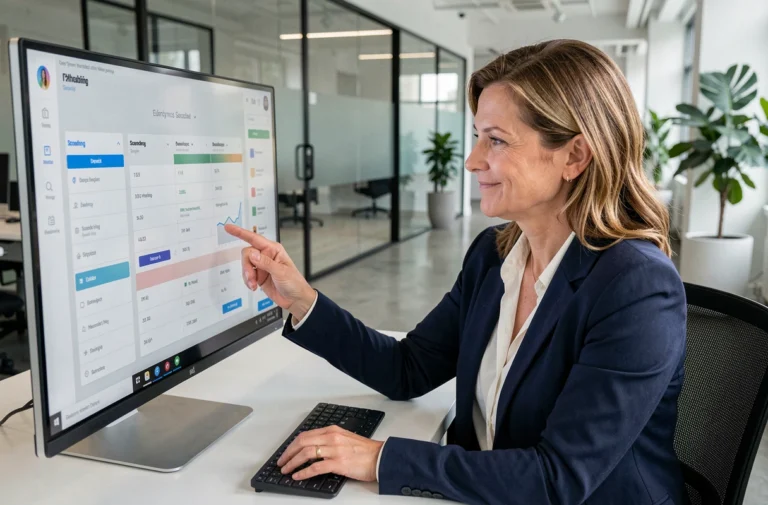
Remote work now holds a prominent place in French companies, representing more than 30% of organizations, whereas it was just a rarity a mere ten years ago. This rapid evolution reflects the massive emergence of digital tools in the professional sphere… and well beyond.
The rise of artificial intelligence in the healthcare sector has already allowed for earlier detection of certain diseases, while personalized educational platforms attract an ever-growing audience each year. The economic and social upheavals accompanying these changes are now evident to all: institutions, businesses, citizens.
Technology at the heart of our daily lives: what concrete changes?
It would be difficult to ignore how much technology has infiltrated our daily lives. It influences our decisions, habits, interactions, work rhythms, and even our leisure activities. Now, a few taps on a mobile app are enough to book a medical appointment, manage expenses, or plan travel. Connected devices such as smartwatches and fitness trackers take over to analyze our heart rate or sleep quality and alert us to prolonged inactivity.
The home, too, is taking on the appearance of a technological platform. Thanks to home automation, lighting, heating, or security can be managed remotely with astonishing ease. Automation extends to energy management as well as cooking. On the entertainment side, streaming services are revolutionizing the consumption of films and music, while video games and virtual reality multiply immersive experiences, blurring the line between real and virtual.
In the healthcare realm, technology is already playing a driving role: diagnostic assistance algorithms, teleconsultations, and remote patient monitoring are becoming commonplace. These advancements energize prevention and transform medical follow-up. To understand the significance of such changes, information on Avenue du Net provides perspective on the positive impact of technologies in today’s society.
Digital transformation: what effects on the economy and social ties?
The upheavals driven by digital transformation are redefining the very foundations of the economy. New sectors, unprecedented jobs, the rise of e-commerce… Information and communication technologies boost innovation and productivity. At the company level, automation reshapes team organization, while remote work expands thanks to collaborative platforms and internet infrastructure. In the face of this dynamic, significant challenges arise: meticulous management of personal data, securing exchanges, not to mention competition that now operates on an international scale.
This upheaval does not stop there: modes of sociability are transforming before our eyes. Social networks broaden spaces for expression and redefine the notion of social life, fostering both the emergence of new connections and unexpected collective actions. Nevertheless, the digital divide still separates: some remain on the sidelines due to lack of access or sufficient training. At the center of the debate, privacy takes a prominent place against the backdrop of exponential data circulation.
Several issues structure this rapid mutation:
- Digital tools: they help energize collaboration and unleash creativity.
- Confidentiality of personal data: regulation and vigilance become essential.
- Accessibility: remaining inclusive requires action against inequalities in access or skills.
In light of these developments, one question arises: will we succeed in steering innovation towards more collective progress without exacerbating existing disparities?

Artificial intelligence and recent innovations: towards a reinvented society
It is impossible to overlook artificial intelligence, which is now establishing itself as one of the spearheads of the digital revolution. Predictive algorithms, machine learning, and virtual assistants are daily disrupting our habits, whether in classrooms, hospitals, or urban planning. The enormous capacity of AI to analyze unprecedented volumes of data accelerates diagnostics, imagines new pathways for sustainable development, or optimizes risk management. In businesses, the automation of repetitive tasks frees up time to focus on analysis, creation, or distinctly human expertise.
Innovation no longer solely equates to technical performance: it also reflects new environmental and societal imperatives. With intelligent resource management, precision agriculture, and energy savings, uses are diversifying rapidly while raising unprecedented questions. Ethical issues, collective responsibilities, and privacy preservation: the pace of progress is accelerating, but our ability to grasp all its implications must keep up.
Challenges and perspectives
Some decisive projects are already opening up to support this revolution:
- Responsibility: distributing technological advancements more equitably.
- Ethics: framing innovation to preserve individual freedoms and values.
- Mental health: supporting transitions so that everyone maintains good mental health in the face of information overload and upheavals in professional norms.
Welcoming technology also means refusing to be subjected to it. It is up to everyone to actively participate in shaping a future where progress leaves no one behind, and where the future is not merely reduced to software or a stream of data.