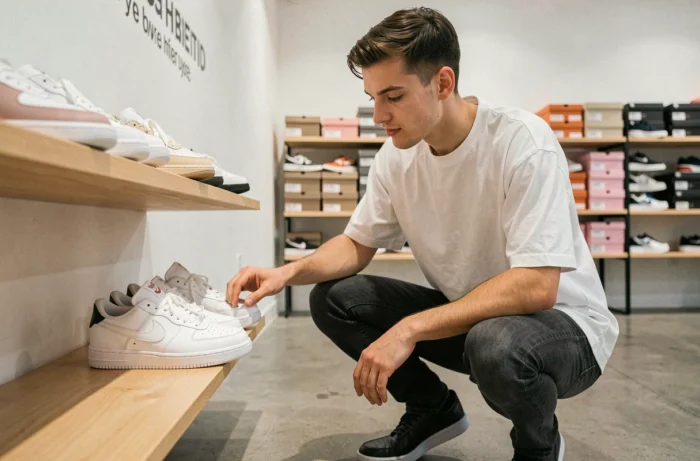
Buying a limited edition pair of sneakers on the secondary market raises a simple question: how can you know if the product is authentic before paying? The platform Wethenew, created in France in 2018, has built its model around this issue. Its operation, guarantees, and positioning compared to other resell players deserve a factual examination.
Wethenew compared to other sneaker resale channels: legal status and guarantees
The choice of purchase channel directly affects the protections available to the buyer. Comparing Wethenew, a professional platform, to a marketplace for individuals or an independent reseller allows for measuring the concrete differences.
| Criterion | Wethenew (professional seller) | C2C marketplace (individual to individual) |
|---|---|---|
| Legal guarantee of conformity | Applicable | Not applicable |
| Right of withdrawal (distance selling) | Applicable | Not applicable under the same conditions |
| Authentication before shipping | Systematic internal control | No standardized verification |
| Recourse in case of counterfeiting | Liability of the professional seller | Limited recourse against an individual |
| Conformity seal | Applied after inspection | Non-existent |
The professional seller status of Wethenew triggers the application of consumer protection rules. This is a structural advantage compared to a transaction on a Facebook group or a peer-to-peer selling app, where the buyer assumes almost all the risk.
As detailed by the site Camille Un Point C’est Tout on sneakers, this legal dimension remains underestimated by buyers who only compare the displayed prices.
Wethenew authentication process: what the control really covers
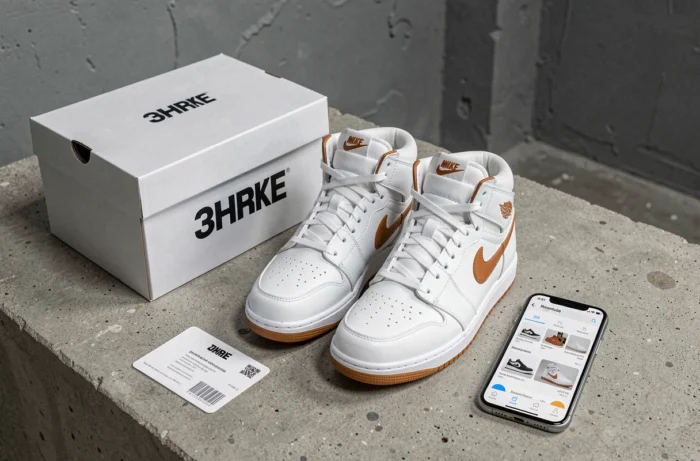
Wethenew claims to perform an authenticity check on every pair before shipping. The mechanism relies on a physical inspection conducted at its facilities in France. Each product received from a seller goes through a dedicated team before being sealed and sent to the buyer.
The verified points focus on several manufacturing markers:
- Compliance of materials, stitching, and finishes with the manufacturer’s standards (Nike, Jordan, adidas, New Balance, ASICS, among others)
- Verification of internal labels, barcodes, and serial numbers specific to each model
- Control of the original box, its condition, and the correspondence between the product and its packaging
- Application of a conformity seal after validation, which serves as tangible proof for the buyer
This process differentiates Wethenew from resellers who rely solely on photos sent by the seller. Physical verification remains the most reliable method for detecting counterfeits, especially for highly copied models like the Nike Dunk Low or adidas Yeezy.
Limitations of the control to be aware of
The authentication pertains to new condition. The pairs sold on Wethenew are neither worn nor refurbished. This positioning excludes the second-hand market, simplifying quality control but limiting the catalog to new, unopened, or barely handled products.
The direct trade-off: prices on Wethenew reflect the cost of the authentication service. A rare model costs more than on a platform without verification, because the control process incurs logistical and human costs integrated into the final price.
Brands and models available on the Wethenew platform
The Wethenew catalog covers the brands that dominate the resale market in France. Nike and Jordan represent the most visible part of the offering, followed by adidas (notably the Yeezy range), New Balance, and ASICS. The platform also offers streetwear, with pieces from brands like Fear of God Essentials.
The most exchanged models remain the Nike Dunk, Air Jordan, and Yeezy, three ranges where demand regularly exceeds supply in stores. It is precisely for these references that the risk of counterfeiting is highest, and thus the use of a platform with authentication makes perfect sense.

Streetwear and catalog expansion
Wethenew is no longer limited to sneakers. The addition of streetwear clothing and perfumes expands the target beyond sneaker collectors. This diversification follows a market logic: buyers of limited sneakers also consume textile pieces from the same brand universes.
The platform, however, remains focused on the premium segment. Limited edition products form the core of the offering, which distinguishes it from a general fashion site.
Environmental regulation and resale of new sneakers in France
Since January 1, 2025, the AGEC law imposes online environmental information for certain new products. Companies that exceed the specified thresholds of turnover and volumes placed on the market must provide a product sheet detailing the environmental impact.
Second-hand or refurbished shoes are excluded from this obligation. Wethenew, which sells new products, is in a monitored area depending on its activity volume. The AGEC framework also prohibits vague mentions like “environmentally friendly” on products and packaging.
No resale platform can therefore claim a generic ecological benefit without exposing itself to a violation. For the buyer, this means that a “green” argument displayed by a reseller without precise data has no regulatory value.
The Wethenew model relies on a verifiable triptych: professional status, systematic physical authentication, and a catalog focused on brands with a high risk of counterfeiting. The higher prices compared to the peer-to-peer market are explained by the cost of these guarantees. The price difference corresponds to the cost of purchasing security, not to an arbitrary margin. For pairs where the risk of fakes is low, the interest in using an authentication platform decreases proportionally.