Wedding trends evolve every year, but the current season marks a clear shift. Couples are no longer looking to replicate a model seen on social media. They are creating a day that tells their story, with aesthetic, culinary, and logistical choices thought out as a coherent whole. Here are the strong themes that are reshaping the organization of the most beautiful day of your life.
Custom Weddings: Staging Replaces Decoration
Have you ever noticed that two weddings with the same colors can create opposite atmospheres? The difference rarely lies in the objects placed on the tables. It comes from how each element fits into an overarching narrative.
Customization is no longer limited to choosing a theme or a color palette. Every detail of the wedding becomes a chapter of a shared story: the secular ceremony ritual written by the couple, the menu that recalls a travel memory, the playlist that follows the timeline of the relationship. This approach transforms the reception into an immersive experience for the guests.
In practical terms, decoration is no longer an isolated aspect. It interacts with the venue, the meal, the music. A couple passionate about the mountains won’t just place fir branches on the tables. They will choose a high-altitude venue, offer an outdoor cocktail reception, and hire an acoustic musician suited to the ambiance.
To keep up with these changes and find inspiration suited to your project, you can consult the Univers Mariage website, which compiles concrete ideas and feedback from service providers.
Contradictory Codes in Wedding Decoration: Mixing Without Mistakes
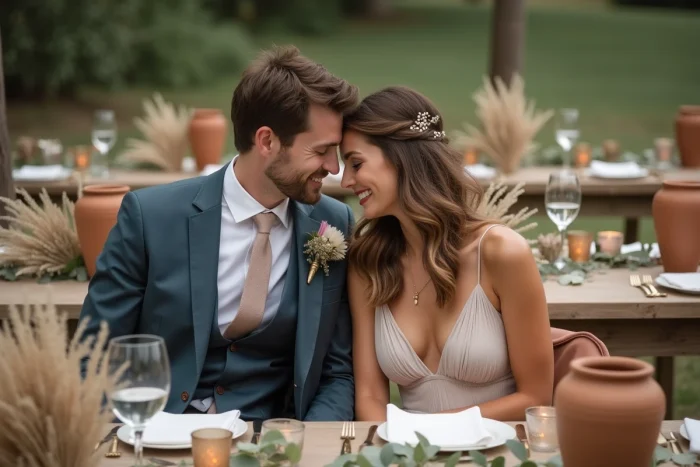
The most visible trend this year can be summed up in one word: hybridization. Weddings are no longer choosing between romantic and contemporary, between minimalism and exuberance. Couples are mixing opposing aesthetic codes to create something that belongs only to them.
A simple example: a reception table set with crumpled linen (very minimalist) topped with imposing golden candlesticks (very baroque). Or soft color palettes (beige, sand, off-white) accented by a bold shade like navy blue or terracotta.
This freedom of mixing has a practical consequence on organization. It requires a stronger overall vision because the risk of slipping into visual disorder increases. Here are a few guidelines to maintain coherence:
- Set a maximum palette of three colors, including a brighter accent color that appears on the invitations, napkins, and flowers
- Choose a unifying material (raw wood, artisanal ceramics, natural stone) that ties together the different areas of the reception
- Limit decorative elements to two stylistic registers, no more, to avoid a flea market effect
The result, when well-balanced, creates a wedding that looks like no other.
Intimate Format and Guest Experience: Rethinking Reception Size
Reducing the number of guests is not just a budget issue. A more intimate wedding radically changes the experience for each person present. Smaller formats allow for more attention to each interaction: personalized welcome, thoughtful seating, plated menu rather than buffet.
Couples who opt for a smaller reception often invest the freed-up budget into the quality of services. A caterer who works with local products offering a tasting menu. A documentary-style photographer who captures spontaneous moments rather than staging multiple poses.
This format also changes the logistics. A smaller wedding opens access to atypical venues (guesthouses, private restaurants, vineyards) that could not accommodate a large assembly. The choice of venue becomes a true creative lever, not just a capacity constraint.
The Wedding Weekend, an Increasingly Popular Format
Some couples extend the day into a full weekend. The principle: gather loved ones from Friday evening for a casual dinner, celebrate the wedding on Saturday, and share a brunch on Sunday morning. This format works particularly well with a limited number of guests because it relies on closeness and shared time.
Anticipating the Date and Venue: The Constraint That Trends Overlook
Articles on wedding trends often focus heavily on aesthetics. They rarely mention the logistical reality that conditions everything else. A wedding requires at least a year of preparation, primarily due to the venue reservation.
In large cities, municipal time slots can also pose problems. The civil date determines the reception date, which determines the availability of the venue, caterer, and photographer. Everything is interconnected.
Here are some often-overlooked points of vigilance in the organization:
- Check the availability of the town hall before booking the reception venue, especially in municipalities where slots are limited on weekends
- Secure the photographer and caterer right after booking the venue, as they are the most sought-after service providers on popular dates
- Keep some flexibility on the date if you are aiming for a highly sought-after venue, even if it means postponing by a few weeks
This anticipation is not a hindrance to creativity. On the contrary, it frees up time later to work calmly on decoration, the menu, and all the details that will make the day memorable.
The most enduring wedding trends are not those that follow a fad. They are those that stem from a couple’s sincere choice, reflected in every aspect of the organization, from the venue to the plate. A successful wedding right now is one where guests leave saying it resembled nothing they had ever known.