
Mike Tyson has long been associated with veganism, to the point of becoming a media figure for the movement. The reality of his diet is more nuanced than the narrative typically relayed. The boxer has gone through several distinct dietary phases, each linked to a specific context: detoxification, weight loss, preparation for a comeback fight, and then transitioning into a businessman.
Joint Pain and Addiction: The Medical Context Behind the Plant-Based Shift
In the early 2010s, Tyson suffered from hypertension, chronic joint pain, and respiratory issues. These conditions, combined with years of addiction, led his medical team to recommend a radical dietary change.
The switch to a vegan diet was not a spontaneous philosophical choice. Doctors and therapists directed Tyson towards an exclusively plant-based diet to reduce joint inflammation and facilitate withdrawal. The primary goal was to stabilize a body that had been severely tested by decades of excess.
Sources close to the boxer report that he also worked on his addictions during this time. The plant-based diet was part of a broader detoxification protocol, not solely a nutritional approach. Several articles detailing Mike Tyson’s vegan or vegetarian diet mention this therapeutic dimension without always elaborating on it.
This medical framework explains why Tyson could describe this period as a “rescue.” The reported weight loss exceeds 45 kilograms, a figure he himself mentioned during a television interview with Oprah Winfrey in 2013.
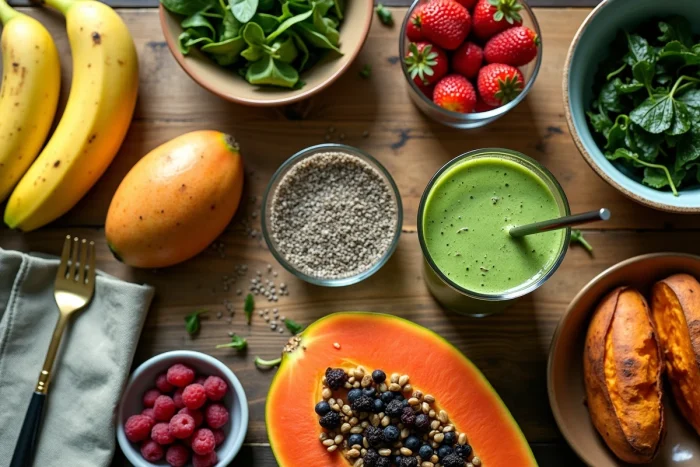
Mike Tyson’s Vegan Diet and Physical Preparation: Two Different Logics
Tyson’s strictly vegan phase mainly corresponds to a period of rehabilitation. When he considered a return to the ring for an exhibition fight against Roy Jones Jr. in 2020, the requirements changed.
Preparing for a fight, even an exhibition, involves working on muscle mass, power, and recovery capacity. In an episode of his podcast “Hotboxin’ with Mike Tyson” recorded with Francis Ngannou, the boxer indicated that he had reintroduced animal products for specific fight preparation.
This distinction between detoxification phase and high-level preparation phase is rarely explored in mainstream articles. Most present Tyson’s veganism as a monolithic block, while his diet evolved according to his physiological needs at the time.
Plant Proteins and Boxing Performance
A heavyweight boxer has protein and energy needs significantly higher than those of a sedentary individual. Meeting these needs with an exclusively plant-based diet is possible, but requires close nutritional monitoring and rigorous meal planning.
Tyson has never claimed to have benefited from such high-level dietary guidance during his vegan phase. What works for weight loss does not necessarily meet the demands of intense physical preparation over several months.
Return to Animal Proteins: What Tyson Says Today About His Diet
Several recent interviews show that Tyson no longer identifies as vegan. In a conversation with YouTuber Patrick Bet-David, he explained that he has reintroduced meat and eggs, believing that a 100% plant-based diet is no longer suitable for his current lifestyle.
This repositioning is accompanied by commercial partnerships focused on products rich in animal proteins. The former champion does not hide this evolution, contrasting with the fixed narrative that many media outlets continue to relay.
- Phase 1 (early 2010s): strict vegan diet in a detoxification and weight loss context, supervised by doctors.
- Phase 2 (around 2020): gradual reintroduction of animal products for physical preparation for the fight against Roy Jones Jr.
- Phase 3 (current period): diet including meat and eggs, publicly acknowledged, with coherent commercial partnerships.
Tyson’s veganism was a phase, not a definitive conversion. This observation does not diminish the results he achieved during this phase, but it prevents him from being presented as a permanent ambassador for the vegan lifestyle.

Mike Tyson and Veganism: The Limits of the Media Narrative
The Tyson case illustrates a common bias in media coverage of celebrity diets. A boxer who loses several dozen kilos through dietary changes creates a powerful, easily shareable narrative.
In contrast, the nuance that follows (reintroduction of animal proteins, adaptation to life context) circulates less effectively. The most shared articles date from the 2013-2015 period, when Tyson was actively discussing his veganism. His more recent statements about returning to meat have received much less attention.
This raises a question about the reliability of nutritional narratives constructed around personalities. A diet that works in a specific context does not constitute a universal prescription. The foods consumed, the duration of the diet, medical supervision, and the objectives pursued are determining variables that the “success story” format tends to obscure.
What Tyson’s Journey Shows About Sports Nutrition
Tyson’s experience confirms a point that sports nutrition specialists often repeat: there is no one-size-fits-all diet suitable for all phases of an athlete’s life. What works for a period of detoxification and massive weight loss does not correspond to the needs of resuming intense training.
The available data do not allow us to conclude that veganism was counterproductive for Tyson. They rather show that he chose to adapt his diet at each stage, which reflects a pragmatic logic more than an ideological commitment.
Mike Tyson’s dietary journey remains a more complex case study than most articles acknowledge. Three distinct phases, three different logics, and a boxer who has clearly always viewed his plate as a tool serving a specific goal of the moment.