Choosing security equipment for your home involves balancing several technologies, various levels of certification, and different budgets. The market offers alarms, cameras, smart locks, and physical protection devices, whose actual performance varies depending on the type of housing and the level of risk exposure.
Certifications and Insurers’ Requirements: The Filter That Changes Selection
In recent years, several home insurers have conditioned their premium reductions, or even the acceptance of risk in the most exposed areas, on the presence of equipment with specific certifications. The most requested standards are A2P for locks and alarms, and NF for remote monitoring systems.
This tightening changes the way of choosing. A motion detector or a camera without certification may work correctly on a daily basis, but will not be recognized by the insurer in the event of a claim. The gap between consumer offerings (often uncertified) and insurance requirements creates a common pitfall when purchasing.
Before comparing features, check with your insurer for the exact list of certifications required by your contract. This point conditions the entire subsequent choice and allows you to evaluate the equipment offered by Protect Habitation against these normative criteria.
Alarm, Camera, Smart Lock: Comparison by Security Function
Each category of equipment covers a different link in the security chain. The table below summarizes their respective roles and limitations.
| Type of Equipment | Main Function | Limitation to Know |
|---|---|---|
| Alarm with Remote Monitoring | Intrusion detection and real-time alert to a monitoring center | Dependence on a monthly subscription, reduced effectiveness without quick human verification |
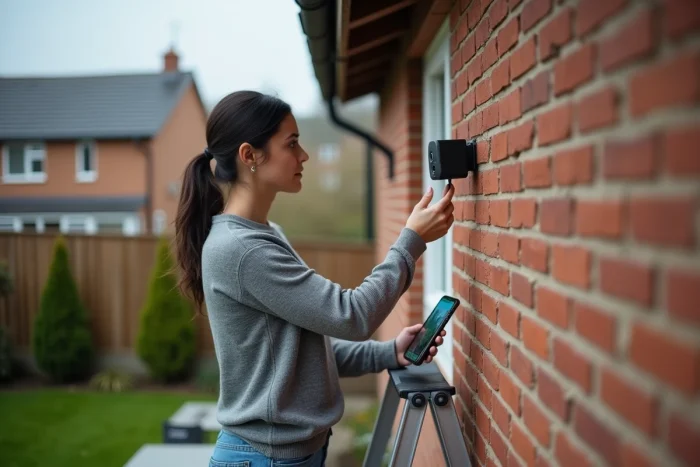
| Surveillance Camera | Video recording, visual deterrence, post-event identification | Vulnerability to hacking if the firmware is not up to date, possible blind spots |
| Smart Lock / Multi-Point Lock | Enhanced access control, remote locking | Risk of electronic failure, need for backup power |
| Detectors (motion, shock, opening) | Triggering an alert at the first sign of attempted break-in | Frequent false positives on entry-level models |
| Reinforced Shutters / Physical Protection | Delay of break-in, mechanical barrier | High installation cost, no alert without coupling to an electronic system |
The “limitation” column is the most useful for making decisions. An alarm system without remote monitoring does not trigger any intervention: the siren alone deters opportunists, but not a determined burglar. In contrast, remote monitoring with quick human verification turns the alarm into a truly active device.
Cybersecurity of Connected Devices: An Underestimated Criterion
The proliferation of connected cameras, locks, and alarms has exposed a blind spot rarely addressed in traditional buying guides. European authorities are now working on cybersecurity frameworks dedicated to connected devices, as part of the Cybersecurity Act.
The goal of this European certification scheme is to guarantee a minimum level of data protection and resistance to attacks on security IoT products. For an individual, this means that a poorly secured connected device can itself become a vulnerability for accessing the home.
Three concrete checks to perform before purchasing a connected device:
- Does the manufacturer publish regular firmware updates, and for how long do they commit to providing this support?
- Is the communication protocol end-to-end encrypted, or do video streams transit in clear text to a remote server?
- Does the product allow two-factor authentication for access to the control application?
A device that does not check any of these boxes presents a digital risk greater than the security benefit it provides.
Home Automation and Absence Scenarios: The Often-Ignored Layer
Motorized shutters, programmable lighting, and connected plugs are not just comfort gadgets in a security system. Coupled with detectors, they allow for simulating credible presence during prolonged absence periods.
A well-constructed home automation scenario opens and closes shutters at variable times, turns on lamps in different rooms, and can even trigger a television. This type of routine reduces the opportunistic nature of a break-in attempt, as visual spotting from the outside does not reveal the absence of occupants.
Most articles on home security treat alarms and cameras in isolation. The most effective approach is to integrate these devices into a comprehensive home automation ecosystem, where each device communicates with others according to predefined scenarios.
Adapting Equipment Level to Housing Profile
The choice cannot be the same for an apartment on an upper floor and a detached house in a rural area. A few discriminating criteria guide the selection:
- The number of access points (doors, windows, patio doors, garage) determines the number of detectors needed and the overall budget.
- The presence or absence of close neighbors influences the choice between a local siren and a system with remote monitoring.
- The network coverage (Wi-Fi, GSM) of the housing conditions the reliability of connected devices, particularly cameras and remotely controlled locks.
- The risk level of the geographical area, assessable via local statistics, may justify an investment in A2P certified physical protections in addition to electronics.
A ground-floor home with multiple access points requires a combined approach (physical protection and electronic detection). An apartment on a high floor with a single access point may suffice with a certified multi-point lock and a connected alarm system.
The best security equipment is not the most expensive or the most technological. It is the one whose certification is recognized by the insurer, whose cybersecurity is documented by the manufacturer, and whose installation covers the actual access points of the housing without blind spots.